GHK-Cu SKIN STUDIES, IN ORDER / 04
Copper peptide skin research: cells, people, and creams
The first study used skin cells. Small human trials came later, followed by tests of how GHK-Cu moves into skin.
What did the first skin study find?
Skin researchers first asked whether GHK-Cu helped repair cells make collagen. In each liter, the two smallest mixes held no more than 10 trillionths of a mole. The largest held under 10 billionths, and all three were below 10 billionths. These strengths belong to lab work, not home use. At each amount, the cells made more collagen [1].
The number of skin repair cells did not rise [1]. Simple cell growth therefore can't explain the extra collagen. Each cell changed what it was doing.
Later work found three soft materials that help skin hold water and keep collagen in order [3]. You don't need the lab names to see how these materials support collagen [3].
A review also covered small studies in people; more collagen was reported in 70% of women using GHK-Cu. The figures were 50% for vitamin C and 40% for retinoic acid [3]. Retinoic acid is another skin medicine made from vitamin A.
The review described more firmness and clarity, with lines that looked less deep. Few people took part; these results carry less weight than a large trial.
At age 20, the paper found about 200 billionths of a gram of GHK in each milliliter. At age 60, it found about 80 billionths of one gram for each milliliter [3]. That drop led researchers toward repair studies; the drop does not tell you that a cream will reverse aging.
The research on copper peptides and hair growth page covers hair roots on its own.
How much GHK-Cu got into or through the skin?
What did GHK-Cu add to skin support?
Skin studies found a rise in collagen plus nearby support material after GHK-Cu. One review recorded a collagen rise in 70% of people using GHK-Cu. The figures were 50% for vitamin C and 40% for retinoic acid [3].
The review gives some support for skin repair; it cannot promise a change in your skin.
Did skin cells make more collagen?
Yes, in cells in a dish; in each liter, the two smallest mixes held no more than 10 trillionths of a mole. The largest held under 10 billionths, and all three were below 10 billionths. At those tiny amounts, the cells made more collagen [1]. Their number did not rise, so simple growth can't explain the change.
That is the clearest GHK-Cu skin finding.
What happened with a strip of human skin?
GHK-Cu crossed the skin very slowly; each hour, the measured move was far below 10 thousandths of a centimeter. The test tracked movement, not whether your skin looked or felt better.
Over 48 hours, 97 micrograms of copper stayed on a skin patch one centimeter by one centimeter [5]. A microgram is a gram split into a million equal parts. The result shows that skin can hold some copper.
GHK without copper does not easily cross the skin's outer layer. A 2025 review checked possible ways to aid its passage. Tiny needles let about 134 nanomoles through; chemists use nanomoles to count very small groups of particles. Untouched skin let none through [14]; the test did not ask whether skin improved.
These findings only describe movement through skin. They do not give you a treatment plan.
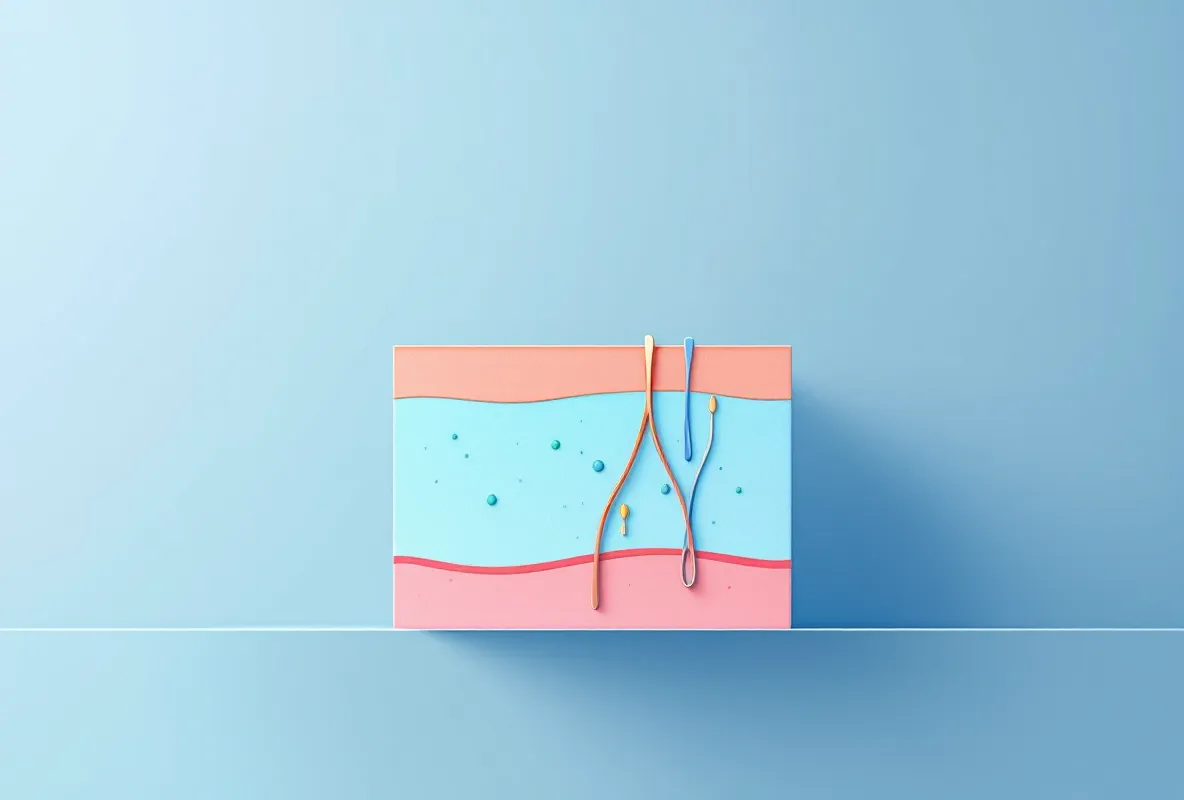
What do tests of a copper peptide serum look for?
What is the main question in a serum test?
A copper peptide serum puts GHK-Cu on skin; the main question is how much enters the skin and how much stays on top.
One study used fat bubbles about 100 nanometers wide. A nanometer is a meter split into a billion parts. One bubble recipe trapped 31.7% of the GHK-Cu added to the mix. Another trapped 20.0% [13]. The first recipe packed more inside, but the test cannot tell you whether either one improved skin.
The bubbles stayed whole for 4 weeks at room heat. In outer-skin cells, they blocked 48.9% of a protein that breaks down elastin. Elastin helps skin spring back. You can't use a cell test as proof that a finished serum is safe.
Other teams used oils, changed GHK, or tiny needles to help it cross skin [13][14].
When did people see firmer skin?
Small face trials compared the cream with placebo, a look-alike cream without the active part. Skin looked smoother within weeks; firmness took about two to three months [3].
How a cream is made matters; one may move GHK-Cu into skin, while another leaves more on top [13][14]. No study can give you one fixed time for every product.
Did GHK-Cu beat retinoic acid in a direct trial?
What comparison appeared in the review?
A review recorded a collagen rise in 70% of people using GHK-Cu. The figure was 40% for retinoic acid [3]; the review did not test retinol. Retinoic acid is another skin medicine made from vitamin A.
The two treatments work in different ways; GHK-Cu helps skin cells make support tissue. Vitamin A treatments give those cells other instructions [3][14]. The review placed separate studies side by side; it wasn't a direct trial, so the figures don't make a fair contest.
The 70%-versus-40% result doesn't prove that GHK-Cu is best.
The firmer finding is the collagen rise in skin cells. The human review also leans toward GHK-Cu, but it can't choose the better product for you [3]. Your skin may differ from the small groups in those studies.